Pursuing a university qualification across Australia represents an incredible milestone, yet for a clear majority of domestic and international students, campus life is only half the reality. The contemporary Australian tertiary landscape demands a highly strategic approach to structural time management. As cost-of-living challenges persist throughout major urban metropolitan centers like Sydney, Melbourne, Brisbane, and Perth, the structural necessity to secure consistent financial income while maintaining academic excellence has never been more pronounced. For the modern student, mastering the delicate equilibrium between corporate shifts and lecture halls is not merely a bonus skill—it is an absolute survival imperative.
Statistical indicators underline the sheer scale of this dual-identity framework. Data points gathered from recent domestic student experience surveys indicate that over seventy-five percent of full-time undergraduate students across Australia remain actively engaged in part-time or casual employment throughout the active academic year. While bringing home a steady income provides immediate relief against mounting weekly grocery bills, residential rental fees, and public transport fares, it inherently creates a structural deficit in available study hours. When your rostered shifts overlap with crucial research windows or final essay preparation periods, stress spikes exponentially. In these moments of extreme pressure, relying on professional academic writing platforms can drastically alleviate organizational burdens. Delegates who strategically choose to delegate assignments to a dedicated academic specialist to do my assignment for me can easily protect their mental health, secure missing personal hours, and systematically defend their grade point average from sudden performance declines.
Key Takeaways for Aussie Students
- Strict Boundaries: Establish inflexible time blocks for lectures, study sessions, professional shifts, and essential personal rest.
- Strategic Delegation: Know when academic back-ups are required to navigate overlapping assignment deadlines smoothly.
- Roster Optimization: Communicate your precise university timetables to employers at least four weeks prior to the standard exam block.
- Health First: Sleep degradation directly correlates with failing grades; do not trade rest cycles for cram sessions.
The Structural Reality of the Student-Worker Identity in Australia
To truly manage the dual pressure of university expectations and casual professional shifts, you must look closely at the underlying structural realities. The typical Australian university semester runs across twelve to thirteen intensive teaching weeks, followed immediately by dedicated study breaks and comprehensive assessment blocks. Each individual unit of study generally dictates an expected layout of ten to twelve total hours of weekly engagement, split evenly between standard face-to-face contact hours (lectures, tutorials, laboratory sessions) and independent self-directed research.
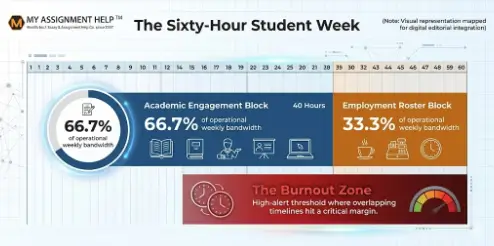
When an undergraduate enrolls in a full-time academic load consisting of four distinct units per semester, the mathematical reality translates directly into forty hours of baseline academic commitment every single week. Introducing an additional fifteen to twenty hours of casual or part-time employment within hospitality, retail, or administrative corporate support sectors creates a massive sixty-hour workweek. Without highly optimized structural boundaries, this severe structural compression inevitably triggers widespread burnout, chronic physical exhaustion, and a noticeable drop in overall academic performance.
Practical Time Management Tactics That Actually Work
Generic productivity platitudes often fail when tested against the practical challenges of student life. Surviving the semester demands robust, proactive systems tailored to the local academic ecosystem. Below are the core organizational strategies deployed by high-achieving students to remain ahead of their schedules.
1. Deploying High-Fidelity Time-Blocking Models
Simple, linear to-do lists frequently collapse when dynamic schedules shift unexpectedly. Instead, high-achieving student-workers use strict time-blocking methods. This approach treats time as a finite physical resource by carving the week into highly specific, functional blocks. Every Sunday evening, map out the upcoming seven days with complete precision. Fixed variables—such as interactive laboratory classes, live tutorials, and rostered workplace shifts—must be placed onto the calendar first.
The remaining open hours are then intentionally designated for focused study or restorative personal recovery. A dedicated three-hour block on Tuesday morning should be strictly labeled for “Unit 104 Secondary Source Reading,” rather than a vague note to “study.” Treat these independent study blocks with the exact same level of professional accountability as a corporate shift. If you would not skip a shift at work, you cannot skip a locked study block.
2. Establishing Strategic Communication Lines with Employers
Managing casual employment demands clear, proactive communication with managers. Many supervisors across Australia’s retail and hospitality industries have navigated higher education paths themselves and understand the seasonal pressures of the academic year. Provide your direct manager with a clear printout of your official university timetable at least three to four weeks before the semester officially begins.
Highlight potential scheduling overlaps early, and establish clear boundaries regarding your availability. When the high-stakes mid-semester submission crunch approaches, request a temporary reduction in weekly shifts well in advance. Offering to pick up extra hours during the mid-year winter breaks or long summer holidays builds valuable workplace trust, ensuring your manager is much more accommodating when you need to focus heavily on your studies.
| Semester Phase | Academic Pressure Level | Recommended Shift Roster | Primary Strategic Action |
| Weeks 1–4: Onboarding | Low / Low-Medium | 15–20 Hours / Week | Build an extensive content repository; complete foundational literature logs early. |
| Weeks 5–8: Mid-Semester Peak | High / Critical | 8–12 Hours / Week | Reduce workplace shifts; prioritize major mid-term projects and research tasks. |
| Weeks 9–12: Concluding Blocks | Very High | 5–10 Hours / Week | Utilize targeted academic support services; finalize complex field portfolios. |
| Exam & Submission Phase | Maximum Limit | 0–5 Hours / Week | Enforce strict leave windows; execute comprehensive exam preparation tracks. |
Protecting Academic Integrity and Managing Submission Cycles
When multi-layered assessment criteria converge simultaneously during the final weeks of the teaching period, administrative paralysis can quickly set in. Academic frameworks across Australian institutions demand exceptional standard proof of original synthesis, deep analytical thought, and correct referencing styles (such as APA7, Harvard, or AGLC). Failing to meet these rigorous criteria due to acute time constraints can compromise your hard work.
When professional shifts drain your available energy, or unexpected research complications slow your progress, taking a proactive approach to managing your workload is essential. Rather than risking generic outlines or incomplete drafts, working alongside highly qualified subject matter experts allows you to maintain momentum. Engaging an experienced academic writer to systematically help you do my assessment ensures your foundational arguments are backed by peer-reviewed literature, structured logically, and aligned with academic expectations. This collaborative approach gives you the breathing room needed to balance professional work while maintaining a high standard of academic performance.
Strategic Academic Warning: Under the Higher Education Support Framework, students must maintain a satisfactory academic progression rate across their enrolled units. Consistent failures due to workplace disruptions can result in conditional academic probations or institutional exclusions. Balancing work with your studies is vital to protecting both your career path and your academic enrollment.
Nurturing Personal Well-being and Mental Health Safeguards
It is easy to focus exclusively on productivity metrics and work output while ignoring essential mental health safeguards. However, working long casual shifts after exhausting multi-hour lectures can quickly impact your physical well-being. Chronic sleep debt undermines memory retention, slows cognitive processing speeds, and leaves you vulnerable to burnout.
Prioritize sleep and physical health above all else. Aim for seven to eight hours of continuous sleep each night to allow your brain to process and retain complex information. Additionally, incorporate small moments of active rest into your weekly routine. Taking a short walk through a local park, scheduling a distraction-free dinner with friends, or stepping away from your laptop for an afternoon can help clear your mind and lower stress levels. Remember, university is a long-term journey of personal growth, not an exhausting sprint that compromises your well-being.
Frequently Asked Questions (FAQ)
1. How many hours can a student safely work in Australia without hurting their grades?
Empirical evidence indicates that keeping your casual workload between twelve and fifteen hours per week offers a manageable balance for full-time students. Going past twenty hours weekly often leaves insufficient time for independent research, increasing the risk of academic burnout.
2. What options do I have if a casual work shift directly conflicts with a final exam?
Under fair work provisions, employers must respect your pre-stated academic commitments. Always provide your official exam timetable to management as soon as it is released. If an unexpected conflict arises, talk to your supervisor immediately to arrange a shift swap with a colleague.
3. When should I look into professional academic support for my work?
If unexpected work rosters, health challenges, or family commitments leave you with insufficient time to complete proper research, seeking professional support is a smart strategy. Working with an expert helps ensure your papers remain well-structured, thoroughly researched, and submitted on time.
4. Can international students work unlimited hours during standard university breaks?
Yes, under current department regulations, visa holders can work unrestricted hours during official university vacation periods. This provides a great opportunity to maximize your income and save a financial safety net ahead of the next semester’s academic pressures.
About the Author
Dr. Elena Rostov Senior Academic Content Strategist & Student Advocate, MyAssignmentHelp
Dr. Elena Rostov holds a PhD in Higher Education Policy and has spent over a decade researching student retention and academic performance trends across Australian universities. As a lead contributor for MyAssignmentHelp, Elena focuses on creating practical, data-driven frameworks that help contemporary student-workers balance complex career ambitions with demanding academic schedules.
Academic References & Local Data Sources
- Australian Government Department of Education (2024). Selected Higher Education Statistics: Student Outcomes and Experiences Portfolio. Canberra, ACT: Commonwealth of Australia.
- Universities Australia (2023). National Student Financial Survey Report: Assessing the Economic Pressures on Enrolled Coursework Undergraduates. Higher Education Research Series, Melbourne, VIC.
- Centre for the Study of Higher Education (2024). The Modern Student-Worker Identity: Evaluating the Impact of Part-Time Employment Cycles on Grade Point Averages. University Research Press, Sydney, NSW.